Results

Comics: Urban stressors in Luxembourg – How Time, Place, and Activities Shape Our Well-Being
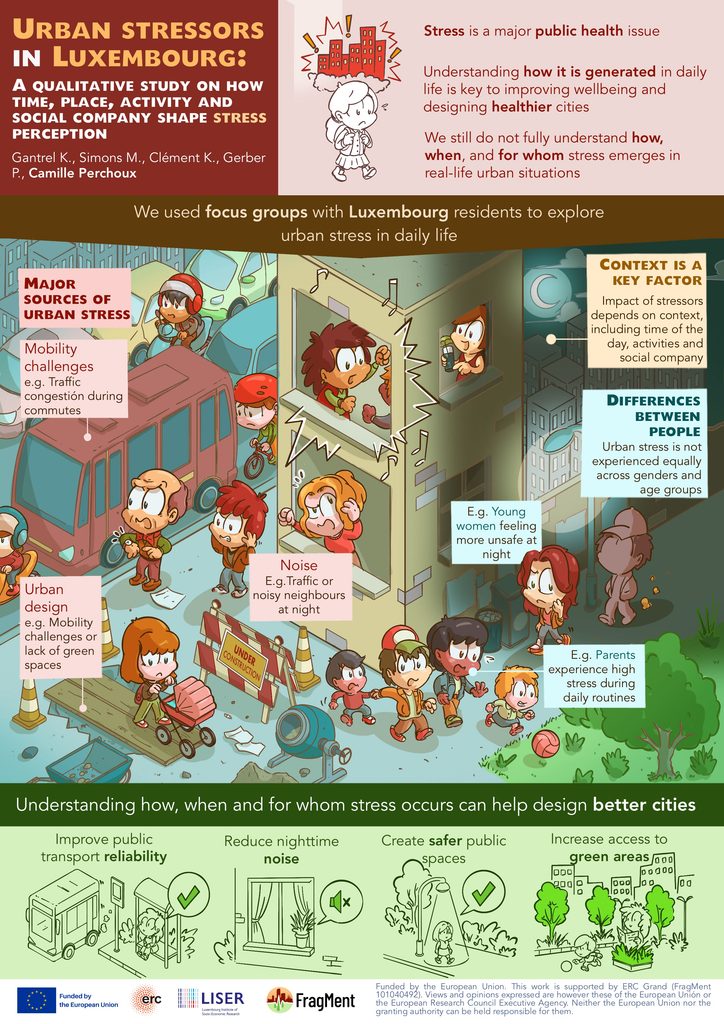

The FragMent study used focus groups with Luxembourg residents to explore how urban stress arises in daily life. Key findings show that stress depends on context—like time of day, activities, and social company—and varies across people. For example, young women may feel less safe at night, while parents experience stress during daily routines. Major stressors include mobility challenges (e.g., traffic congestion), noise (e.g., traffic or noisy neighbors), and urban design issues (e.g., lack of green spaces). Understanding these patterns helps design better cities by improving public transport, reducing nighttime noise, creating safer spaces, and increasing access to green areas.
Publication: What methods are suited to study urban stress in daily lives? The FragMent study protocol

Perchoux et al. 2025

The FragMent study explores how our daily environments—like parks, busy streets, or quiet neighborhoods—affect stress levels. Using smartphones, maps, and voice recordings, researchers investigate the environments people visit, how they interact with them, and how stressed they feel in real time. Over 2,000 adults in Luxembourg participate, with 200 providing detailed data for 15 days. The study combines surveys, GPS data, and voice analysis to uncover links between surroundings, activities, and stress. Findings will help design healthier cities and improve well-being. Results are shared on fragmentproject.eu.

Publication: Can Virtual Reality Help Us Understand Urban Stress?

Aghanejad et al. 2026

How does the design of our cities affect our stress levels?

The FragMent team explored this question by asking 50 adults to walk through virtual versions of an urban park and a busy street. Participants felt significantly less stressed, safer and more relaxed in the park. Researchers also measured physical responses, including heart rate, sweating and pupil size. When a virtual fire truck sounded its siren, changes in sweating and pupil size helped detect an immediate stress response. The findings suggest that virtual reality could help urban planners understand how streets affect wellbeing and design healthier, less stressful urban spaces.

Publication: Can Virtual Reality Help Us Design Better Cities?

Ghanbari et al. 2026

How do our streets influence the way we feel when walking?

The FragMent team explored this question by comparing real-life walks with virtual reality (VR) experiences involving 47 adults. Participants experienced two types of streets: pedestrian-friendly areas and streets dominated by traffic. The results showed that people felt safer, more comfortable, relaxed and happier in pedestrian-friendly environments, both in real life and in VR. However, real-world walks generally produced more positive feelings than virtual ones. These findings suggest that VR can help urban planners test street designs and develop healthier, more enjoyable cities for everyone.

Publication: Voice Signatures of Momentary Psychological Stress in Real-Life Environments: Results from the Colive Voice Study

Can your voice reveal how stressed you are? 

Stress is one of the biggest health challenges of our time, and finding easy, non-invasive ways to detect it could transform how we monitor mental health. Stress changes the way we speak: our pitch, the smoothness or breathiness of our voice, even how long we pause.

In this study, 4,155 people recorded their voices at home, in everyday conditions. We analyzed their recordings and attempted to find common signatures of stress between them.

The results confirmed that stress does leave measurable traces in the voice, but the specific markers varied by gender and language. There was no single universal “stress signature”, but we found that with stress, voice stability, intensity, pitch and pauses changed. This matters because it shows that building a voice-based stress marker will require personalized approaches rather than a one-size-fits-all tool.